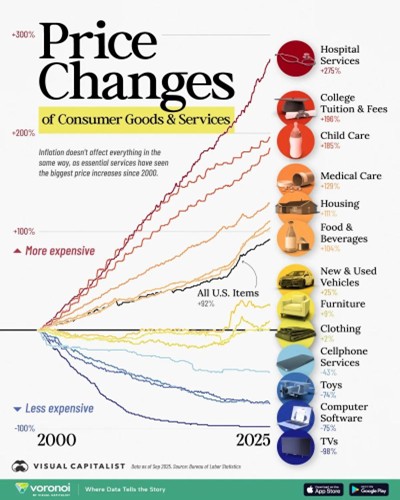
Have you stopped to think about this . . . In 21st-century America, luxuries are cheap; living is expensive.
That inversion explains more about today’s economic stress than many policy debates care to admit.
For much of the late 20th century, the opposite was true. Housing, healthcare, education, and transportation consumed a smaller share of household budgets. Luxuries were discretionary. The act of building a stable life did not require extraordinary income growth or financial complexity.
That world no longer exists.
Many of today’s public policies and planning frameworks, however, still assume it does. They are rooted in cost structures and household economics that are 20 to 30 years out of date. When those assumptions persist, even well-intentioned strategies struggle to deliver meaningful results.
A recent data visualization shared by my LinkedIn contact Dave Messner hit me like a lightning bolt.
Essentials now dominate household spending in ways that were once unthinkable. Housing and healthcare, in particular, exert more pressure across income levels, reshaping how families make decisions and absorb risk.
I see this personally as well as professionally.
I have two children, both University of Georgia graduates, both newly minted homeowners, each doing what prior generations were told would lead to stability. I am proud of them. I am also realistic about the economic terrain they are navigating. The new economic strain means the margin for error is thinner.
I’m not here to tell you times were better back then, but I am here to tell you that times are DIFFERENT.
If we want to create positive outcomes in communities today, we need the discipline to update our assumptions.
Some “tried and true” tools still work. Good ideas do not, necessarily, expire simply because conditions change. But they still need to be viewed through the lens of today’s realities rather than yesterday’s assumptions.
At KB Advisory Group, our work starts from that premise.
We focus on helping communities understand how today’s households actually live, spend, and absorb costs, and what that means for housing policy, infrastructure investment, and economic development strategy.
If this perspective resonates, and you are thinking about how your community adapts to these 21st-century realities, I am always open to a conversation.
We’re here for the work.
Geoff Koski President & Owner KB Advisory Group geoff@kbagroup.com www.kbagroup.com